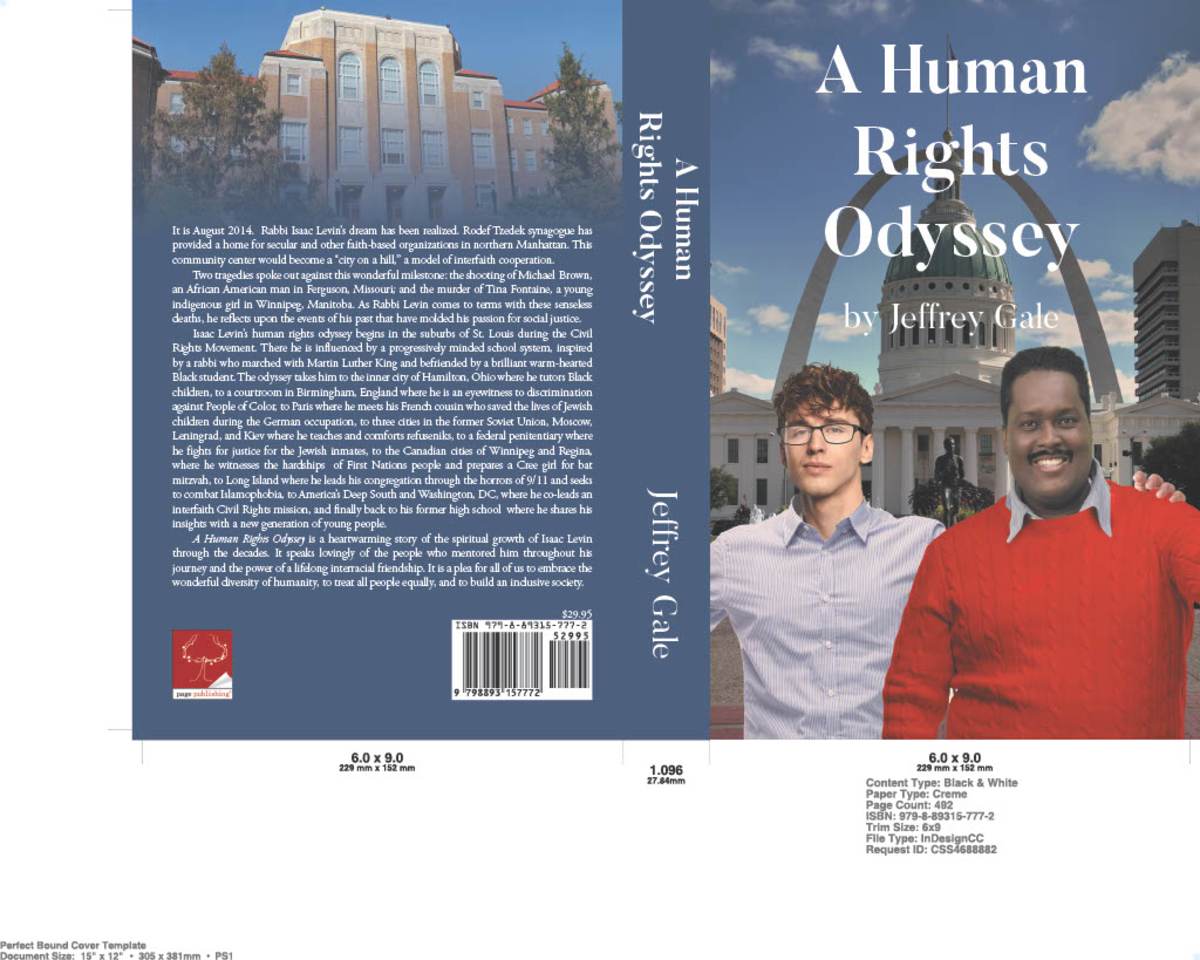
My personal goal for many years was to write about the evolution of my social activism from my youth during the heyday of the Civil Rights Movement. The duties of the pulpit rabbinate prevented me from seriously putting pen to paper, so to speak. When I wrote my first two books, I went in a different direction. They focus on specific social issues. The Ballad of East and West focused on Soviet Jewry in the early 1980s. The Secret of Redemption focused on interfaith relations and the sanctuary movement in the United States as well as the Israel-Palestinian conflict in Israel. The book drew parallels between American Manifest Destiny and Revisionist Zionism. Upon completion of Book 2, I revisited my goal to write a human rights odyssey which would be much more global in scope.
In early August, I was planning an interfaith Thanksgiving program with my colleagues in Northern Manhattan. Soon after our deliberations, I learned of the senseless killing of Michael Brown in Ferguson, Missouri. Shortly afterwards, I travelled to Winnipeg, Manitoba with my wife and learned that an aboriginal girl, Tina Fontaine, had been pulled from the Red River. These two senseless deaths caused me to reflect on my encounters with major historical events and human rights issues throughout the decades.
In A Human Rights Odyssey, Parts 1 and 2 are primarily flashbacks which deal with red letter events in Rabbi Levin’s life: living through the Civil Rights era, teaching and comforting Russian refuseniks, ministering to Jewish inmates at a federal penitentiary, preparing a Cree girl for her bat mitzvah in an environment which was hostile to Canadian aboriginals, navigating a Long Island congregation through the tragedy of 9/11 and reaching out to Muslims living in the area. Part 3 deals with the maturation of Rabbi Levin’s social consciousness as he co-leads a diverse group of high school students on a mission to the Deep South and Washington, D.C., return to his old high school and addresses a new generation of students, and finally executes a successful interfaith Thanksgiving program with his Christian and Muslim colleagues.
The name, Isaac Levin, was a deliberate choice. Isaac was considered the weak link of the patriarchs. As an adult, he was not a great mover and shaker like his father, Abraham, or his son, Jacob. He was simply a transmitter of Jewish tradition. Isaac Levin does not see himself as a charismatic figure or some type of a savior, but merely a transmitter of the Jewish prophetic tradition, Levin was based on the co protagonist of Tolstoy’s, Anna Karenina, Konstantin Levin. Konstantin Levin was a rich landowner who was disillusioned with the shallowness of the Russian aristocracy. Throughout much of the novel, he searches for higher spiritual meaning in his life and at one point, works in the field with the peasants who serve him. Isaac Levin also searches for spiritual meaning, by becoming involved in various causes throughout the decades. Just as Konstantin Levin worked with peasants, so Isaac Levin worked with Black and Latino children in the inner city. I desperately wanted to create a protagonist who undergoes great spiritual growth throughout the novel. Konstantin Levin was transformed from an agnostic to a believer. Isaac Levin evolved from a naïve spectator to a religious leader who stepped up to the plate whenever he confronted injustice, to a true social activist who moved beyond reacting to crises and became proactive in initiating projects.
Although A Human Rights Odyssey is largely autobiographical and could have easily been written in a non-fiction format, I chose to use fiction instead. Because most people don’t live plotted lives, some dates and events were massaged to advance the plot and to enhance story telling. Because many of the characters were based on actual people, most names were changed to ensure confidentiality. The autobiographical components give authenticity to my story and provide a personal touch to a work which is classified as historical fiction.